Where in the World Is Yoomie?
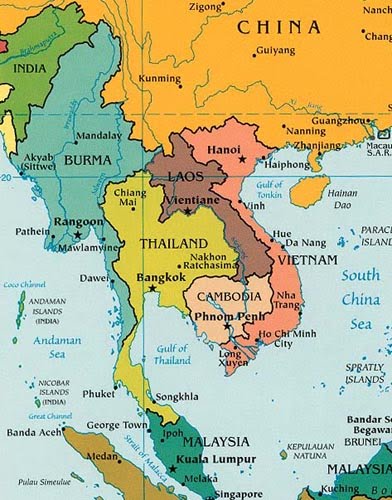
Location: Back in Siem Reap, Camboodia working for Senhoa.
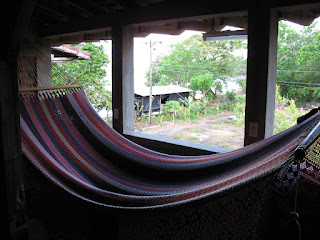
It is hard to believe that after witnessing such disparity on the ride from Playa Venecia to Merida, that safely locked behind the yellow gates of Hacienda Menda lays wireless internet, river-rock built showers, and lakeside view cabins with beautiful hand-made hammocks. Secluded in our lakeside hostel resort, the travelers marvel at the heavenly conditions. I pay US$8/night for my room – the most expensive of all the options.
 The travelers I met are in their twenties, either traveling solo or in pair. The solo ones have teamed up with other solo travelers, increasing strength in language abilities and discounts. I am the short-term traveler, with my three weeks and three countries. Others have a time frame of six weeks, five months, indefinitely...or "until the money runs out." Unlike me and my centralized location in Heredia/San Joe, Costa, they have started in the north in either Mexico or Honduras making their way south to pass Nicaragua, Costa Rica, Panama and into South America. Among them, I don't feel so much like an outsider in my vagabond ways: living out of my camping backpack and hand washing my clothes. Together, we are friends amongst the 5.5% unemployment population in our developed countries - too independent and carefree to be strapped to any desk job.
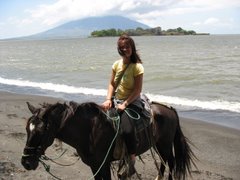
The lake here is reminiscent of a sea with its rough waves and long sandy coastline. Horses, chickens, pigs, dogs are let to run loose. The chickens walk freely amid the dogs at Hacienda Merida – where I stayed my last two nights on the island. I will miss this island when I am safely back in my air-conditioned bus to San Jose, Costa Rica. I will miss its brightly hand-woven hammocks, scenic landscape views, banana tree fields, dirt roads, slow pace of life, freshly made tamarindo juice, curious faces, and sparse English phrases…and maybe, just maybe even the roster that crows all hours of the night and early morning.
Additional photos:
 I will end up staying three nights on Isla de Ometepe, hopping from one town to the next – from Moyogalpa to Playa Veneica to Merida. I am taken by this little island. The view from the taxis ride reveal handwashed clothes hung out to dry on chicken wire fences staked every meter by broken tree branches, concrete frames of unfinished structures left empty, shacks of uninhabitable homes crowded with people, ‘open’ kitchens in backyards, and wandering livestock.

At 6am, I am woken by the sound of an annoying roster cock-a-doo-do-ing right outside my room. I thought I had left the alarm sounds of neighboring rosters and window-knocking birds behind in Costa Rica for lazy mornings in… By 7:30am, the roster is still going at it. This family own hostel of Hospedaje Lidia in Rivas has an open courtyard where the family hangs their hand-washed clothes on roped clothes lines, cooks breakfast over an open fire, and gathers for meals – family and hostel guest alike – on picnic style tables. On my way to checkout, I noticed the croaking had stopped…the rooster had be placed in boiling water to loosen its feathers. Ah, the twisted hand of fate.
 As I arrived to San Jorge to catch the ferry Isla de Ometepe, I get my first view of the volcanoes. Ometepe is formed by two large volcanoes caused by flowing lava that formed an isthmus that united them into a single island. In the mist of vast Lake Nicaragua, Volcan Maderas and Volcan Concepcion rise like two massive horns. San Jorge is no more than a ferry stop. There is a local woman selling palm-sized mangos. “Cuanto cuesta?” I asked. “Dos cordobas para cino,” she replies. With the exchange rate of C$18 to US$1, each mango was US$0.02. I give her a bill for C$10. She S-L-O-W-L-Y counts back my change in C$1 coins…1…2…3…4…as she reaches 6, I tell her to keep the change.
It’s an eight hour bus ride from San Jose, Costa Rica to Rivas, Nicaragua. I ditch the idea of relying on the infamous local “chicken buses” (with their liberal ‘bring what you want' policy, i.e. chickens) to cross the boarder for the more comfortable, air-conditioned, movie-watching-enabled, reserved seating arrangement of international buses. The drive through northwest Costa Rica show winding roads littered with modest open cafes, fruit farmers, and ninos on bicycles.
Seven hours later, the bus arrives at the boarder crossing between Costa Rica and Nicaragua (via Sapoa). It is quite busy, full of idling trucks and tour buses. From immigration to customs, the whole process takes a bit over an hour. As I wait in line for my passport stamp, I almost get ripped-off by a couple of moneychangers. With their rubbed-off, overused button calculators, they take advantage of my poorly spoken Spanish. C$1680 (cordobas) for US$160 at the exchange rate of 10.5:1? I don’t think so. Luckily I had google the current exchange rate before departing. We finally settled on an exchange of 17:1, at a lost of US$8.90.
 The travelers I met are in their twenties, either traveling solo or in pair. The solo ones have teamed up with other solo travelers, increasing strength in language abilities and discounts. I am the short-term traveler, with my three weeks and three countries. Others have a time frame of six weeks, five months, indefinitely...or "until the money runs out." Unlike me and my centralized location in Heredia/San Joe, Costa, they have started in the north in either Mexico or Honduras making their way south to pass Nicaragua, Costa Rica, Panama and into South America. Among them, I don't feel so much like an outsider in my vagabond ways: living out of my camping backpack and hand washing my clothes. Together, we are friends amongst the 5.5% unemployment population in our developed countries - too independent and carefree to be strapped to any desk job.